
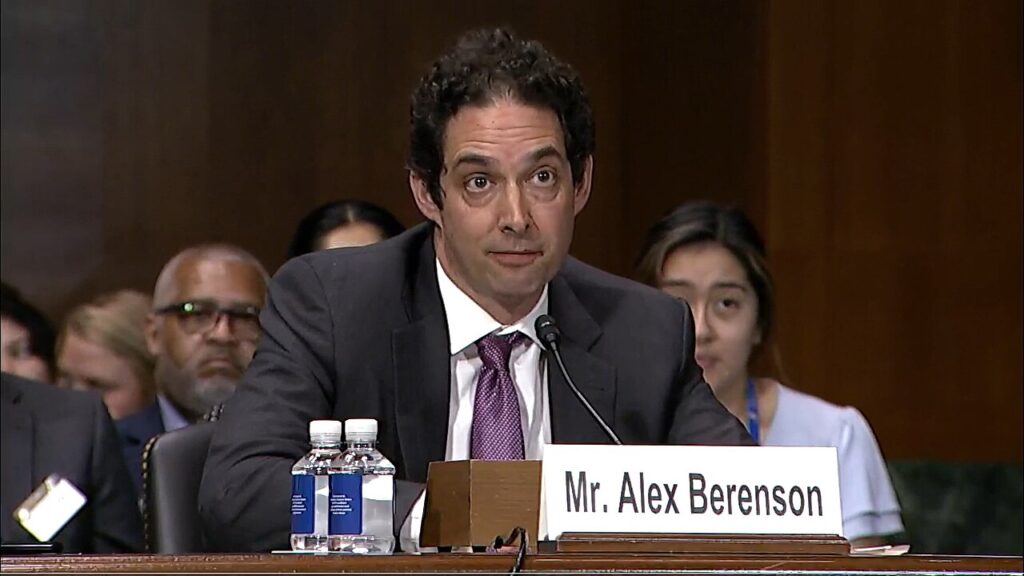

An investigation into the infrastructure, incentives, and revenue streams behind prohibition advocacy — using professional writer Alex Berenson’s career as a case study in how misinformation survives evidence.
Key Takeaways
- Six years after Alex Berenson’s predictions of cannabis-driven crime and psychosis epidemics, the data show neither materialized.
- Being wrong has not ended his media career — subscriber-driven revenue models reward narrative consistency over factual accuracy.
- National violent crime data for 2024 show continued declines, including a 14.9% drop in murder.
It seems to me that the pattern that emerges when examining contemporary anti-cannabis discourse, which I have been doing for a while now, is not primarily ideological but economic. Modern media ecosystems reward narrative consistency over factual accuracy; revenue streams generate rational incentives to ignore contrary evidence; and professional misinformation infrastructures can survive, sometimes even thrive, after empirical refutation.
Alex Berenson’s trajectory since 2019 provides a useful case study. Not because he is exceptional, but because his career as a successful novelist and professional writer exposes the mechanics of how prohibition advocacy adapts when its predictions fail.
In January 2019, Berenson — a former New York Times reporter and bestselling novelist — predicted that cannabis legalization would trigger epidemics of psychosis and violent crime. He even called his book Tell Your Children, as a way to evoke the most profound fear real parents have: that our children will suffer from a damning mental illness… in this particular case as a consequence of poor advice.
Six years later, recreational cannabis is legal in 24 states, serving more than 150 million Americans, and medical cannabis is allowed in 40 states.
The catastrophes Berenson forecasted never arrived. Violent crime did not surge in legalization states. Homicide epidemics did not materialize. The apocalyptic mental-health collapse he warned of failed to appear.
The catastrophes Berenson forecasted never arrived. Violent crime did not surge. Homicide epidemics did not materialize.
Yet Berenson’s media career continues to generate revenue. According to Substack’s own subscribe page, Unreported Truths has over 236,000 total subscribers. Paid tiers are currently set at $9 a month or $63 a year, with a founding-member option at $350 a year; a free tier also exists. Applying a standard industry paid-conversion estimate of 3–5% suggests a paid subscriber base in the range of 7,000 to 12,000 readers and annual gross revenue conservatively in the low-to-mid six figures, depending on the tier mix. Add speaking-circuit fees and recurring appearances on Fox News and adjacent outlets, and contrarian advocacy gives the indication of being financially sustainable.
Even after being systematically contradicted by evidence, being wrong can still pay. This might give us a hint on why updating one’s position based on evidence is often economically irrational in subscriber-driven media markets.
236,000+
Total subscribers to Berenson’s Unreported Truths newsletter, per Substack’s own subscribe page. Paid tiers range from $9/month to $350/year. A free tier also exists. Paid conversion rates in subscriber media typically run 3–5%.
The Coordinated Amplification Model
Berenson’s 2019 book, Tell Your Children: The Truth About Marijuana, Mental Illness, and Violence, received extraordinary media placement. Within a single week, he published op-eds in The New York Times and The Wall Street Journal, appeared multiple times on Fox News, and was the subject of a glowing 4,000-word feature by Malcolm Gladwell in The New Yorker, which praised his “reporter’s tenacity” and “outsider’s knack for asking intemperate questions.”
This simultaneous placement across competing publications — Times, Journal, New Yorker, Fox — within days suggests a level of campaign infrastructure exceeding routine book promotion. Whether coordinated formally or through happenstance, the effect was clear: rapid legitimacy across elite and mass platforms.

The immediate policy impact demonstrated the model’s short-term effectiveness. Illinois Senator Dick Durbin cited Gladwell’s piece while urging caution on legalization. The intervention failed — Illinois legalized in January 2020 — but it showed how mainstream credibility, elite endorsement, and synchronized amplification can briefly influence legislative debate.
At the same time, the scientific response was swift and public. Researchers whose work Berenson cited began disputing his interpretations almost immediately. Within weeks, multiple scholars and clinicians from Columbia, Harvard, and NYU signed an open letter describing the book as “based on a deeply inaccurate misreading of science” and an attempt to “stir up public fear.”
Dr. Ziva Cooper, a member of the National Academies committee whose report Berenson relied on, told Rolling Stone: “To say that we concluded cannabis causes schizophrenia is just wrong — and it’s meant to precipitate fear.” Undark described the book as “statistical malfeasance.”
The libertarian Reason Foundation concluded that his characterization of the literature was insufficient for policy modeling.
“To say that we concluded cannabis causes schizophrenia is just wrong — and it’s meant to precipitate fear.”
Dr. Ziva Cooper, National Academies committee member, to Rolling Stone
Six years from then, we can find Berenson still hitting the same bell.
The Six-Year Test
What makes Berenson’s case analytically valuable is time. His claims were explicit, causal, and testable. Six years of post-legalization data now allow empirical evaluation.
It is not merely that some studies find no statistically significant long-term increase in violent or property crime following legalization in early-adopting states like Colorado and Washington. It is not even that multiple analyses suggest crime trends in legalization states track national patterns rather than diverging upward. If Berenson’s causal story were correct and if legalization were triggering a psychosis-to-violence cascade at the population scale, the signal would be unmistakable. You would see sustained violent-crime surges concentrated in legalization states.
Instead, 2024 national data show violent crime decreased an estimated 4.5% from 2023 to 2024, with murder and non-negligent manslaughter falling an estimated 14.9%, according to the FBI’s most recent annual report.
–14.9%
Drop in murder and non-negligent manslaughter in 2024, per the FBI’s most recent annual crime report. Violent crime overall declined 4.5% from 2023 to 2024. The homicide surge Berenson predicted has not materialized.
You would also see homicide curves bending upward as legalization expanded to nearly half the country. They did not.
Furthermore, you would see a generalized youth mental-health collapse linked to cannabis normalization. Instead, federal surveys show adolescent substance use — including marijuana — remaining historically low relative to prior decades.
You would see psychiatric systems overwhelmed across demographics. Instead, the most credible recent healthcare studies identify narrow, conditional effects: increases in psychosis-related emergency visits concentrated among specific subgroups, primarily men aged 25–34, primarily in states with weak regulation of high-potency products. Cannabis scholars and regulators have warned that THC concentrates must be controlled and that the public must be advised against abusing them. It’s the leap critics such as Berenson take from this moderate public-health concern to concluding cannabis should remain under prohibitionist constraints that is unjustifiable.
What’s also relevant is that other analyses found that states with more medicalized or pharmaceutical-style regulatory models were associated with better mental-health outcomes.
In other words, the data do not support Berenson’s apocalyptic narrative.
They support a far more mundane conclusion: that market design and product regulation matter and that legalization itself is not the driver of societal breakdown.
Perhaps most tellingly, one outcome is unequivocal. Legalization and decriminalization dramatically reduce cannabis possession arrests — often by 40–80% — shrinking the criminal-justice footprint of marijuana enforcement even before downstream effects are debated.
The “crime wave” Berenson warned about coincided, in practice, with fewer people being criminalized for cannabis at all.
The absence of the predicted signal is itself evidence. When a theory forecasts catastrophe at national scale and six years of real-world exposure fail to produce it, the problem is not insufficient data.

Discourse Adaptation When Predictions Fail
What is instructive is how the discourse adjusted once evidence accumulated.
In a January 2025 appearance on The Megyn Kelly Show, Berenson did not revise his position. He reasserted it. “I think the book is its own best evidence,” he said.
“I think the book is its own best evidence.”
Alex Berenson, January 2025, on The Megyn Kelly Show
When comparisons between cannabis and alcohol arose, he shifted argumentative ground entirely, moving from claims about psychosis-driven violence to assertions about psychological addiction — claims that have been disputed repeatedly. Both the host and the guest agreed that alcohol was less addictive than cannabis and less dangerous, because of its lack of association with violent crimes. The argumentative ground had moved so far from the original claims that it was essentially a different argument entirely.
Once a public brand is built around a contrarian position, financial incentives favor maintaining that position regardless of evidence. Subscriber-based income depends on audience retention within specific ideological markets. Updating one’s stance based on data risks alienating the very audience that pays.
Academic researchers who disputed Berenson’s claims face the opposite incentive structure. They gain no financial reward from refutation. Their professional capital depends on methodological rigor and reputational credibility. Berenson, a novelist and professional writer, does not need to obey those masters.
The two systems reward fundamentally different behaviors.
When income depends on confirming audience fears rather than correcting them, epistemic flexibility becomes a liability.
Partisan Framing and Ideological Market Segmentation
Berenson’s own website — still foregrounding Tell Your Children as its primary calling card — symbolizes a logic according to which maintaining the original narrative is more profitable than engaging six years of contradictory data.
But the world did change, and cannabis is much more bipartisan now than it was back then.
Anti-cannabis discourse finds a limit as it relies increasingly on framing legalization as partisan warfare, despite repeated evidence that voter-driven legalization runs across both aisles. Oklahoma legalized medical cannabis while voting overwhelmingly Republican. Montana legalized recreational use under the same conditions.
Still, the partisan frame serves the different function of audience capture. By casting scientific criticism as “the left” rejecting uncomfortable truths, prohibition advocacy aligns itself with broader grievance narratives common to right-leaning media ecosystems.
Berenson’s post-2019 migration into MAGA-adjacent media followed a similar logic to his COVID-era contrarianism, which culminated in his suspension from Twitter in 2021, before his account was reinstated after Elon Musk’s acquisition of the platform.
Identify an audience skeptical of institutions, deliver content validating that skepticism, and monetize attention.
Policy Impact and the Evidence Gap
Did anti-cannabis discourse shape policy? Briefly. Senator Durbin’s intervention shows short-term influence. But Illinois legalized anyway. National support for legalization continued rising, surpassing 70% by 2023. State cannabis tax revenues exceeded $15 billion. The costs of prohibition — criminal justice expenditures, racial disparities, illicit-market violence — remained visible and measurable.
Fear-based narratives ultimately collapsed under observational reality. Voters could see that legalization did not produce chaos. The evidence gap widened until the discourse lost credibility outside its core audience.
This highlights the limits of profitable misinformation in empirically testable domains. Individual messengers can sustain careers within ideological niches even as mainstream influence fades, but policy trajectories tend to realign with observable outcomes once enough time passes.
At least, that appears to be the case with cannabis.
This article is based on public reporting, FBI data, linked source materials and six years of documented post-legalization data. Where facts remain disputed or unproven, that is stated in the text. This article is a reported analysis. The commentary, views or interpretations expressed do not imply that any uncharged conduct has been proven in court unless explicitly stated. Readers are encouraged to review the underlying materials and draw their own conclusions.