As the November election approaches, Nebraska candidates for Congress are pledging to stand with voters in support of medical marijuana access—in part by ousting members of the current delegation who have worked to undermine cannabis reform while the state is inexplicably excluded from federal non-interference protections that exist for other states.
During a webinar hosted by Americans for Safe Access (ASA) and Nebraskans for Medical Marijuana on Monday, Nebraska State Sen. John Cavanaugh (D) and independent Dan Osborn—who are running for U.S. House and Senate, respectively—joined advocates for the launch of a campaign aimed at supporting patient medical marijuana access and states’ rights to set their own cannabis policies without the threat of federal intervention.
“Medical cannabis is on every federal ballot in 2026,” Steph Sherer, founder and executive director of ASA, said. “The next Congress will decide whether cannabis is fully integrated into American healthcare—or left vulnerable to political rollback impacting the millions of Americans, seniors, veterans, children with severe conditions, cancer patients, and people living with chronic illness who rely on cannabinoid medicines.”
“The Compassionate Candidate Campaign gives patient advocates the tools to educate candidates about their needs and how to address them in federal statute,” she said. “The Compassionate Pledge makes clear, when patients head to the ballot box, which candidates are prepared to represent them.”
That pledge—which counts Cavanaugh and Osborn among its initial signatories—is a commitment by candidates to cosponsor legislation in Congress creating a national medical cannabis program under the U.S. Department of Health and Human Services (HHS).
“Candidates in every district are applying for the job of representing us,” Sherer said. “Patients are demanding Medical Cannabis Champions at the ballot box this year. The pledge makes it unmistakably clear who is prepared to lead.”
Cavanaugh said that “Nebraskans made it clear that patients deserve safe and legal access to medical cannabis,” and “it’s time for Congress to catch up.”
“I signed the Compassionate Pledge because patients should not have to live in fear or uncertainty when following their doctor’s recommendations,” he said. “A national framework that treats cannabis as medicine may be the only way to ensure the will of Nebraska voters is respected.”
On Monday, the state senator reflected on the years-long push in Nebraska to secure medical cannabis—a fight that continues in the face of opposition from top state officials, certain lawmakers in the legislature and members of the state’s current congressional delegation such as Sen. Pete Ricketts (R-NE).
“We fought all of these battles, and we’ve had people pay lip service to those things on the floor of the legislature and not carry forward,” Cavanaugh said. “Now we have seen this very troubling aspect, where the federal exemption for Nebraska has been left out, which was, I think, driven by our delegation and its continued attempt to undermine what the people want.”
The lawmaker was referencing the fact that, while nearly all medical cannabis states are covered under a congressional appropriations rider preventing the use of federal funds to interfere in state programs, Nebraska is oddly excluded from that list.
“I’m running for Congress for a number of reasons, but one of them is that we need to make a change at the national level,” he said. “We need congressional action that is actually going to allow the people of Nebraska to get the medicine that they voted overwhelmingly for, and to allow these families to provide medical care that they desperately need for their children.”
“We will continue to make progress in every place or push forward every place that we can until…all of these kids are able to get the medicine that we have voted for and that we’re promising to them,” Cavanaugh said.
Osborn, a military veteran and industrial mechanic, said he’s motivated to provide medical marijuana protections for patients based on his belief in “personal freedom and accountability.”
“I have seen firsthand how outdated federal policies hurt real people. Nebraskans who need medical cannabis deserve respect, access, and research; not stigma or more bureaucratic limbo,” he said. “I signed the Compassionate Pledge because I plan to fight for patients’ rights the moment I arrive in Washington.”
Today I signed the @SafeAccess Compassionate Pledge, committing to fight for a national medical cannabis program the moment I get to Washington.
71% of Nebraska voters approved medical cannabis, but @PeteRicketts has done everything he can to OBSTRUCT the will of the voters.… pic.twitter.com/4lG99INB0a
— Dan Osborn (@osbornforne) February 16, 2026
The U.S. Senate candidate said it’s an “important” issue to him, but it’s ultimately “pretty simple” because he’s standing with the 71 percent of Nebraskans who voted to provide medical marijuana access on the ballot in 2024.
“They voted for it. They signed the petitions. They showed up. My job that I’m applying for is to represent the people, and the people in this state have already spoken,” he said, adding that “there’s a lot of people in pain and “a lot of veterans suffering from PTSD—and they’re furious that politicians keep getting in the way.”
“This really isn’t a partisan issue. The only people that are fighting it are politicians who think they know better than the patients and the caregivers, which is completely ridiculous to even think of that notion,” Osborn said. “But as an industrial mechanic, I know people with pain that never leaves, who can’t sleep through the night, who are handed opiates instead of options, and they deserve every treatment that science has to offer. Medical cannabis is certainly one of them.”
“We need the federal law changed so that no hostile commission, no attorney general, no billionaire politician can keep standing between Nebraskans and their medicines,” he said. “Right now, without federal legislation, millions of patients face an impossible choice: Follow your doctor’s advice, risk losing benefits, federal benefits, housing, job even—and nobody should have to choose between their rights and their health.”
“Federal prohibition is also blocking the research that this medicine deserves science. Science should be driving this, not politics,” he continued. “When I’m elected senator, what it means for Nebraska is finally to have a senator who will vote and align federal law with the science and with the will of the people. I will cosponsor legislation to build a real national medical cannabis program with proper safety standards, real research investment and protections so patients are not penalized for following their doctor’s advice.”
“The families who have been waiting over a decade earned this. And you know, I’m going to make the fight real,” he said.
Crista Eggers, the mother of a child with severe epilepsy who benefits from cannabis and the lead petitioner behind Nebraska’s medical marijuana campaign, represents one of those families. And she said that, when it comes to the state’s exclusion from the congressional rider, “this wasn’t an oversight in our eyes.”
“Our current U.S. senator, Pete Ricketts, has been one of the most outspoken anti-medical cannabis officials, I believe, in the country,” she said. “I think this is really the final straw for us… I think it leaves patients in a very, very difficult position—a compromising position—and what the effects will be, I think, has us very scared.”
In Nebraska, the process of standing up the state’s medical marijuana program has been rife with complications. But Gov. Jim Pillen (R) this month started accepting applications to replace the chair of the voter-established Medical Cannabis Commission who resigned. Concerns about that commission remain high among advocates, however, and there are additional worries about the prospect of expanding the body’s authority under a recently filed bill in the legislature.
—
Marijuana Moment is tracking hundreds of cannabis, psychedelics and drug policy bills in state legislatures and Congress this year. Patreon supporters pledging at least $25/month get access to our interactive maps, charts and hearing calendar so they don’t miss any developments.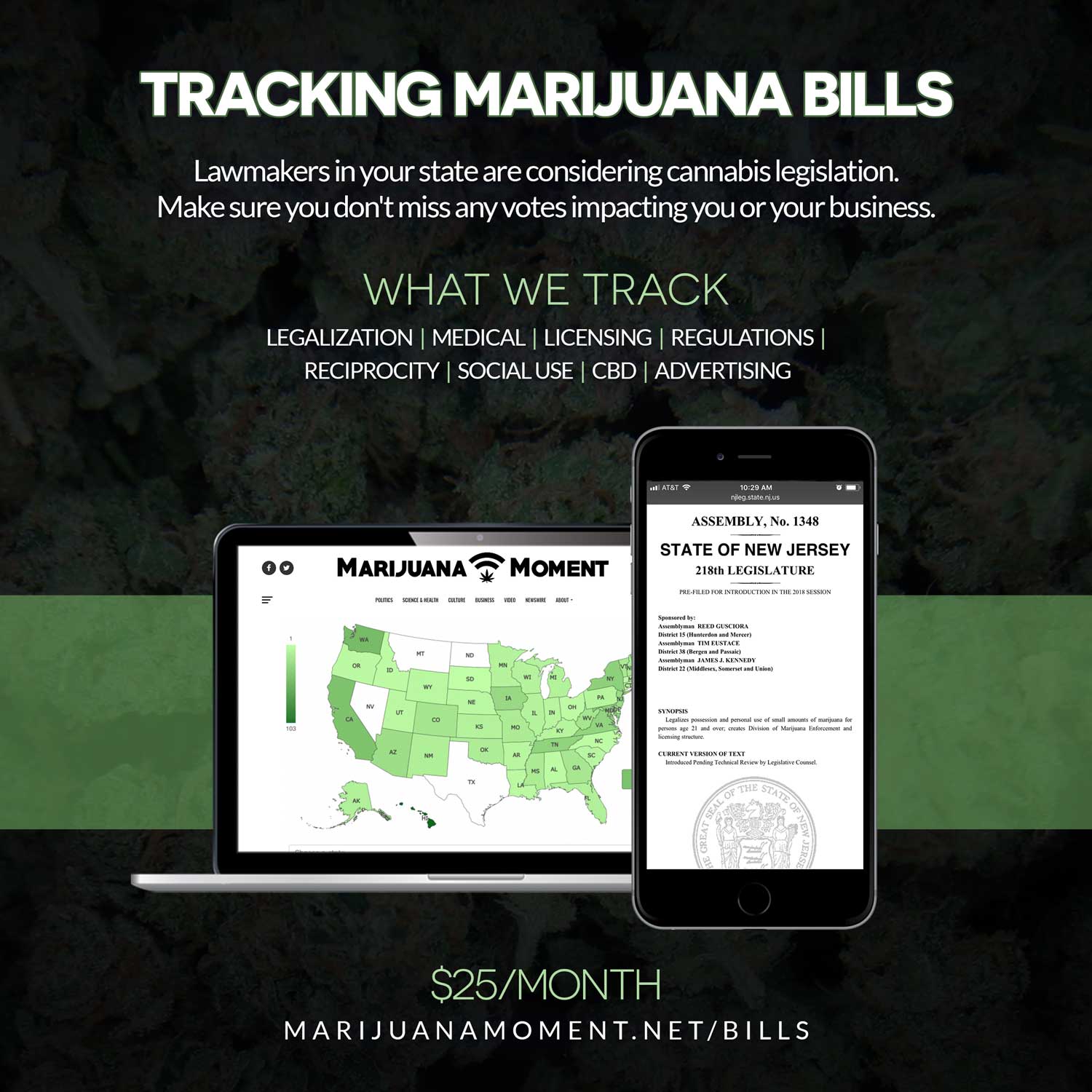
Learn more about our marijuana bill tracker and become a supporter on Patreon to get access.
—
Meanwhile, last November, a Native American tribe in Nebraska, as well as cannabis reform activists, punched back against the governor and state attorney general over comments suggesting that people would be prosecuted if they buy marijuana from businesses on its reservation.
While the state approved its first medical cannabis business license to a cultivator, there is still no lawful means for patients to access products yet.
Meanwhile, last year, Nebraska activists filed an initiative to legalize marijuana and establish a constitutional right to use cannabis for adult over the age of 21. If organizers collect enough valid signatures from registered voters, it could appear on the 2026 ballot.
The marijuana reform push also comes as the state attorney general is cracking down on sales of intoxicating hemp-derived products, including those containing delta-8 THC.
The approval of two medical marijuana ballot measures in 2024 came after an earlier attempt in 2020 gathered enough signatures for ballot placement, but saw the measure invalidated by the state Supreme Court following a single-subject challenge. Supporters then came up short on signatures for revised petitions in 2022 due in large part to the loss of funding after one of their key donors died in a plane crash.
Photo courtesy of Max Pixel.
Marijuana Moment is made possible with support from readers. If you rely on our cannabis advocacy journalism to stay informed, please consider a monthly Patreon pledge.
