
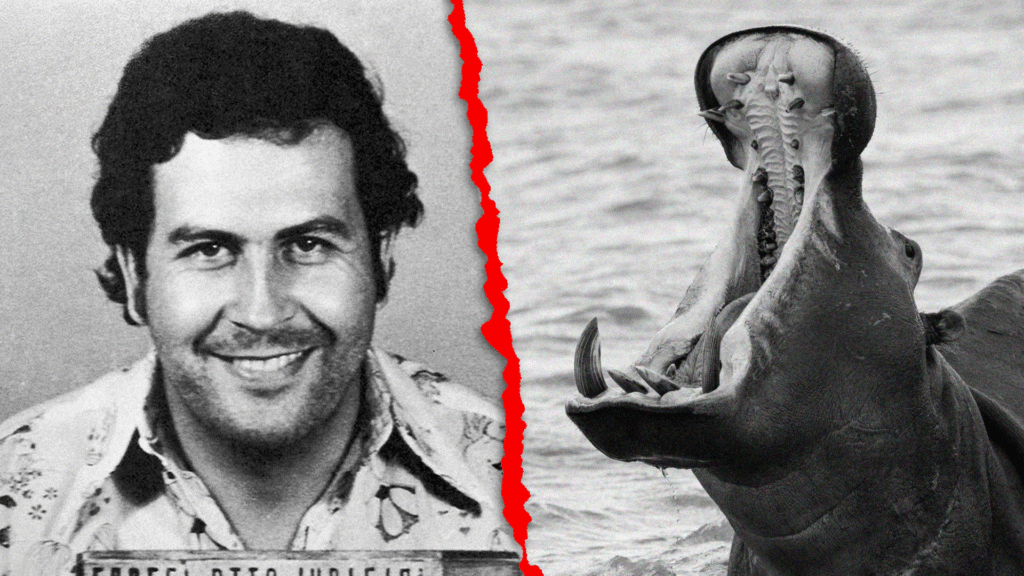

Colombia is moving forward with a controversial plan to euthanize dozens of invasive hippos descended from Pablo Escobar’s private collection, as their population continues to grow uncontrollably. The decision highlights a complex clash between environmental protection, public safety, and animal welfare, with no easy solution in sight.
- How Did Non-Native Hippos End Up in Colombia, and Why Are They a Concern for the Government?
- Colombia plans to euthanize at least 80 hippos
As early as 2022, Colombia’s growing hippopotamus population had become a topic of concern. And for good reason: although hippos have not caused a single death in the country, Colombian authorities recognize that this wild population does not belong to the local ecosystem. As a result, it has no natural predators, allowing unchecked expansion and widespread disruption of the landscape.
And that’s not all: even though they haven’t caused major incidents in Colombia, data from Uganda—where hippos are native—shows that 87% of encounters between this species and humans have been fatal.
But these aren’t just any hippos. They were once the pets of one of Latin America’s—and arguably the world’s—most notorious drug traffickers: the infamous Pablo Escobar Gaviria. Today, Colombia still holds Escobar responsible for this relentless expansion and is actively seeking ways to curb it. Current projections estimate that the population could reach around 500 hippos by 2030—and double just five years later.
How Did Non-Native Hippos End Up in Colombia, and Why Are They a Concern for the Government?
In the 1980s, Pablo Escobar Gaviria brought four hippos to Colombia as part of his private collection. They lived on his Hacienda Nápoles estate alongside other exotic animals, including giraffes, elephants, zebras, ostriches, rhinos, and buffalo.
But in 1993, the narco-empire collapsed with the death of the powerful drug lord, leaving the estate completely abandoned. Some animals were relocated, but no one wanted to take in the hippos. Left behind, they escaped and spread throughout the Magdalena River basin.
Decades later, their numbers have risen in ways few could have predicted. What began with just four animals has grown to an estimated 169 to 200 hippos today, according to various sources. Projections suggest that the number could climb to 500 by 2030 and 1,000 by 2035, making this the only wild hippo population outside of Africa.
Hippos devour, compete, disrupt, and reshape
Officially designated an invasive exotic species since 2022, hippos have no natural predators in Colombia, giving them “free rein” to devour large quantities of native flora, compete with local wildlife, disrupt the ecosystem, alter the landscape with their footprints (they weigh over a ton), and pollute the water with their excrement.
Furthermore, they impact species such as manatees and river turtles by altering water quality, reducing aquatic vegetation, and altering the ecosystems on which these species depend for feeding and reproduction.
They have also affected humans, encroaching on fishing areas, rural communities, and even a schoolyard. Fishermen are afraid of them, and they make their work more difficult. Additionally, encounters between children, residents, and these animals create ongoing tension in many areas due to the risk of attack they pose.
So how have they thrived so successfully in a non-native environment? The expansion of hippos in Colombia comes down to two key factors that have enabled their growth: plenty of water and abundant food. They live like kings—at least for now.
Colombia plans to euthanize at least 80 hippos
Initially, Colombia considered “relocating” some of the animals to avoid resorting to lethal measures. In fact, as mentioned earlier, nearly all the animals from Escobar’s private zoo were eventually rehomed, except for the hippos. But why did no one want them?
The problem is that all of Colombia’s hippos are direct descendants of the original four that Pablo Escobar brought in. In other words, they are all closely related. In biology, when there is little genetic diversity, the same genes are repeated over and over again, which increases the likelihood of genetic defects.
If greater genetic diversity means better health, this situation is the exact opposite. If a population descends from a small number of individuals and breeds within the same family, there is a higher risk of disease and a lower capacity for adaptation. This can lead to birth defects, malformations, health problems, reduced disease resistance, and more reproductive issues.
This lack of genetic diversity is one of the main reasons other countries and zoos have shown little interest in taking them in: they are not particularly suitable for conservation programs because they do not contribute to genetic diversity, are more prone to health complications, and are more costly and complex to maintain. This is why the Colombian government has found it so difficult to relocate Pablo Escobar’s hippos, whose numbers have grown exponentially in recent decades.
In addition to the idea of transferring them to other zoos, Colombian authorities have also attempted chemical sterilization and explored exporting the animals abroad. It’s not that solutions weren’t pursued; none proved effective at slowing population growth. This leads to the current plan: euthanizing 80 hippos in an effort to reduce the population in a controlled, sustained way.
The new plan was announced by Minister Irene Vélez, who stated that the goal is to reduce the population by at least 33 individuals per year under the Plan for the Prevention, Control, and Management of the Invasive Exotic Species Hippopotamus, with a total budget of COP 7.2 billion (approximately USD 2 million).
Each procedure will cost COP 50 million (USD 14,000) per animal, not including additional costs such as international transport (which is very costly) and mandatory burial for health reasons.
The process is expected to be quick: the animals will be injected, and some will be shot with darts, following a protocol described as “ethical, safe, and responsible.” According to the government, this measure—while unfortunate—is scientifically necessary and was considered a last resort after multiple failed attempts at alternative solutions.
Experts warn that without immediate action, the situation could spiral out of control within the next 10 to 20 years. Animal rights groups, however, strongly oppose the plan, andSenator Andrea Padilla has even described the measure as “short-sighted and cruel”. They argue that if the animals were brought into the country as victims of human decisions, then non-lethal solutions should be prioritized. The dilemma is complex: animal ethics versus ecological preservation, and human responsibility versus damage control.
But the challenges are clear, and the obstacles significant: dozens of countries have already made it clear that they are not willing to take in the hippos that were once the pets of the region’s most notorious drug trafficker; the logistical cost of relocation is extremely high (though it would need to be weighed against the cost of euthanizing 80 animals); the genetic issues these hippos have reduced their “value” for conservation; previous measures have failed; and the population of this species continues to grow.
It is clearly a one-of-a-kind case: African wildlife that has become a Latin American pest. Anecdotal and peculiar, sure, but it has turned into a real and problematic environmental crisis that poses significant environmental and public safety concerns.
Photo by Colombian National Police, Public domain, via Wikimedia Commons (edited)