
Federal transportation officials are rolling out a public education campaign aimed at encouraging people not to drive under the influence of marijuana on or around the upcoming unofficial cannabis holiday known as 4/20.
“Relevant, timely messaging is an important addition to any communication plan, as it creates an opportunity for engagement with the community,” the National Highway Traffic Safety Administration (NHTSA) said of its new campaign pegged to Monday’s stoner holiday.
“On the 20th of April, also known as 420—a number associated with marijuana use—marijuana users might observe a day of increased marijuana use,” the agency said. “We have themed material that reminds drivers: If You Feel Different, You Drive Different and that it’s dangerous and illegal to drive impaired.”
The campaign includes graphics and sample press releases that state and local agencies can use to encourage people in their areas not to operate motor vehicles while impaired.
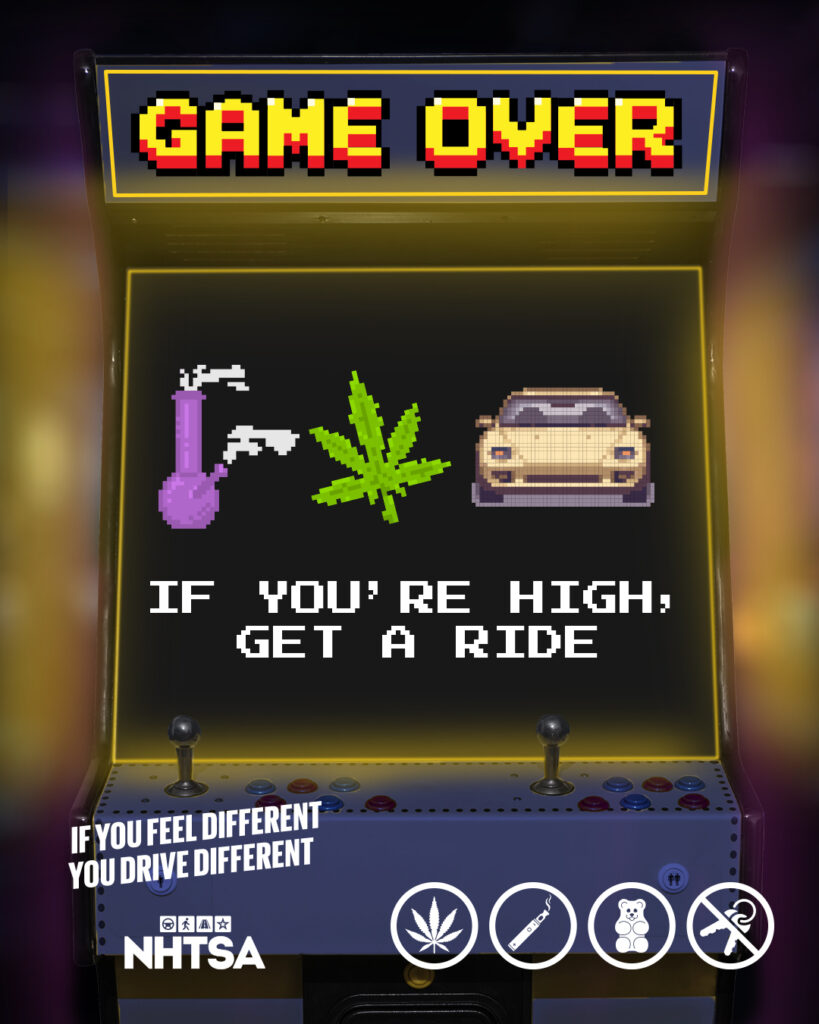
One ad depicts a video game arcade cabinet that says “Game Over” and “If You’re High, Get A Ride.” The screen shows a bong with smoke coming out, a cannabis leaf and a car.
NHTSA, which is part of the U.S. Department of Transportation, also provides talking points about the issue, including suggestions that people “designate a sober driver who won’t be using any drugs or call a ridesharing service or taxi.”
It also reminds consumers that in every U.S. state and territory—including those that have legalized cannabis use and sales—it remains illegal to drive under the influence.
“Whether the drug is legally obtained or not, drug-impaired driving poses a threat to everyone on the road,” it says. “If you think driving while high from marijuana won’t affect you, you are wrong: It has been shown that marijuana can slow reaction times, impair cognitive performance, and make it more difficult for drivers to keep a steady position in their lane.”
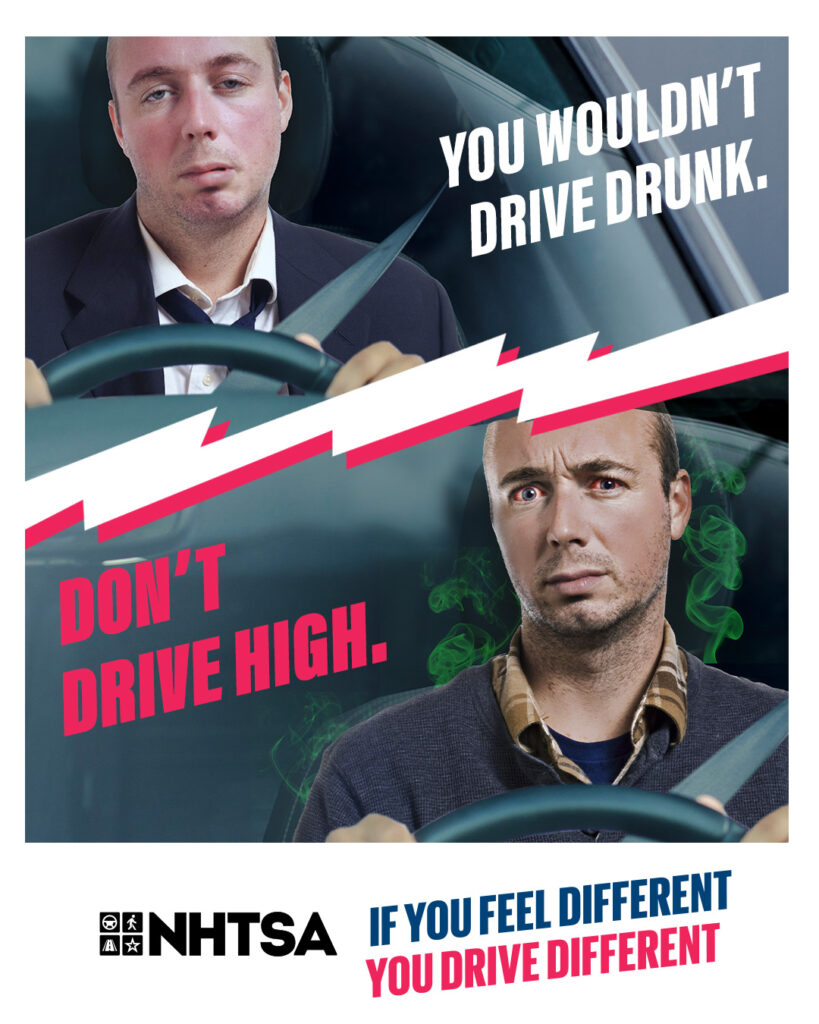
Another ad in NHTSA’s 4/20 campaign shows a man separately appearing to be intoxicated from alcohol and high on marijuana and says, “You wouldn’t drive drunk. Don’t drive high.”
The agency is also providing suggested text for electronic highway message boards:
- DRIVING HIGH
RISKS LIVES
DRIVE SOBER - AVOID THE HAZE
DRIVE SOBER ON
420 AND 24 7 - A SOBER RIDE
KEEPS EVERYONE
ALIVE ON 420 - DONT DRIVE HIGH
SECURE A SOBER
RIDE ON 420
The 420-themed campaign is just one of several “special activations” under NHTSA’s broader If You Feel Different, You Drive Different campaign. Others are pegged to Fourth of July, Halloween, Thanksgiving and winter holidays.
NHTSA recently partnered with the Ad Council on a separate campaign to “challenge the dangerous belief that it’s safe to drive after consuming marijuana,” with a disturbing ad that they said depicts a real-life story of a child killed by a driver who was under the influence of cannabis.
That campaign represented a departure from recent cannabis-related NHTSA ads, which have taken a less “Just Say No” approach to marijuana use risk messaging and, at times, leaned into to cannabis culture to promote education around the potential consequences of driving while high.
What stood out about the messages and graphics was the lack of fear-mongering and negative depictions of cannabis consumers that’s long been a hallmark of federal marijuana PSAs, such as those funded by the White House Office of National Drug Control Policy (ONDCP) in the 1990s and 2000s that perpetuated stigmas about laziness or forgetfulness.
Instead, NHTSA seemed to be leveraging cannabis culture, with warnings against impaired driving that are coupled with images meant to appeal to marijuana consumers.
It’s unclear if the more recent shift to alarmist messaging is directly or indirectly responsive to language in a spending bill approved by the House last year that would block the federal traffic safety agency from supporting ads to “encourage illegal drug or alcohol use.” Prohibitionists have celebrated the inclusion of those provisions.
NHTSA Administrator Jonathan Morrison said in August that he was prepared to “double down” on increasing awareness about the risk of marijuana-impaired driving in partnership with the White House.
In 2021, meanwhile, NHTSA tried to get the word out about the dangers of impaired driving through an ad featuring a computer-generated cheetah smoking a joint and driving a convertible.
Critics noted that the world’s fastest land animal hardly fits the stereotype of a cannabis consumer that the government has historically played into, while other commenters pointed out at the time that the ad made the cheetah look confusingly cool as he’s broke the law.
The agency also played on horror-movie tropes in a 2020 ad featuring two men running for their lives from an axe murderer. The pair ultimately find a vehicle to escape the scene, but the driver pauses before he turns the key in the ignition. “Wait wait wait,” he says. “I can’t drive. I’m high.”
While it’s widely understood that driving under the influence of cannabis is dangerous, the relationship between consumption and impairment is a messy one.
In 2024, for example, a scientific review of available evidence on the relationship between cannabis and driving found that most research “reported no significant linear correlations between blood THC and measures of driving,” although there was an observed relationship between levels of the cannabinoid and reduced performance in some more complex driving situations.
“The consensus is that there is no linear relationship of blood THC to driving,” the paper concluded. “This is surprising given that blood THC is used to detect cannabis-impaired driving.”
Meanwhile, the Department of Justice recently announced a new breakthrough in the development of a marijuana breathalyzer, with a study partly funded by the federal government showing a potential pathway for a “portable, low cost” device that looks like an inhaler for asthma, built with 3-D printed material that can detect delta-9 THC without secondary lab analysis.
Federal agencies outside of DOJ have also recognized the need for the THC detection technology. For example, last year the National Institute of Standards and Technology (NIST) under the U.S. Department of Commerce planned a workshop aimed at facilitating “an open and candid discussion” about the development and implementation of device to test a person’s breath for marijuana impairment.
In 2023, a federally funded report by researchers at NIST and the University of Colorado Boulder concluded that evidence does “not support the idea that detecting THC in breath as a single measurement could reliably indicate recent cannabis use.”
A DOJ researcher in 2024, meanwhile, cast doubt on whether a person’s THC levels are even a reliable indicator of impairment, saying states may need to “get away from that idea.”
That issue was also examined in a federally funded study in 2024 that identified two different methods of more accurately testing for recent THC use that accounts for the fact that metabolites of the cannabinoid can stay present in a person’s system for weeks or months after consumption.
Also that year, researchers behind a federally funded study said they’d developed new procedures to enhance the selectivity of a popular forensic testing method, allowing better detection of delta-9 THC and its metabolites in blood.
A study published in 2019 concluded that those who drive at the legal THC limit—which is typically between two to five nanograms of THC per milliliter of blood—were not statistically more likely to be involved in an accident compared to people who haven’t used marijuana.
Separately, the Congressional Research Service (CRS) in 2019 determined that while “marijuana consumption can affect a person’s response times and motor performance … studies of the impact of marijuana consumption on a driver’s risk of being involved in a crash have produced conflicting results, with some studies finding little or no increased risk of a crash from marijuana usage.”
In a report in 2024, NHTSA said there’s “relatively little research” backing the idea that THC concentration in the blood can be used to determine impairment, again calling into question laws in several states that set “per se” limits for cannabinoid metabolites.
“Several states have determined legal per se definitions of cannabis impairment, but relatively little research supports their relationship to crash risk,” that report said. “Unlike the research consensus that establishes a clear correlation between [blood alcohol content] and crash risk, drug concentration in blood does not correlate to driving impairment.”
Marijuana Moment is made possible with support from readers. If you rely on our cannabis advocacy journalism to stay informed, please consider a monthly Patreon pledge.
