

Despite concerns from marijuana legalization opponents who claimed the policy would lead to skyrocketing use by teens, cannabis consumption by middle and high school students in Minnesota is lower now than it has ever been over the past decade, according to newly published state data.
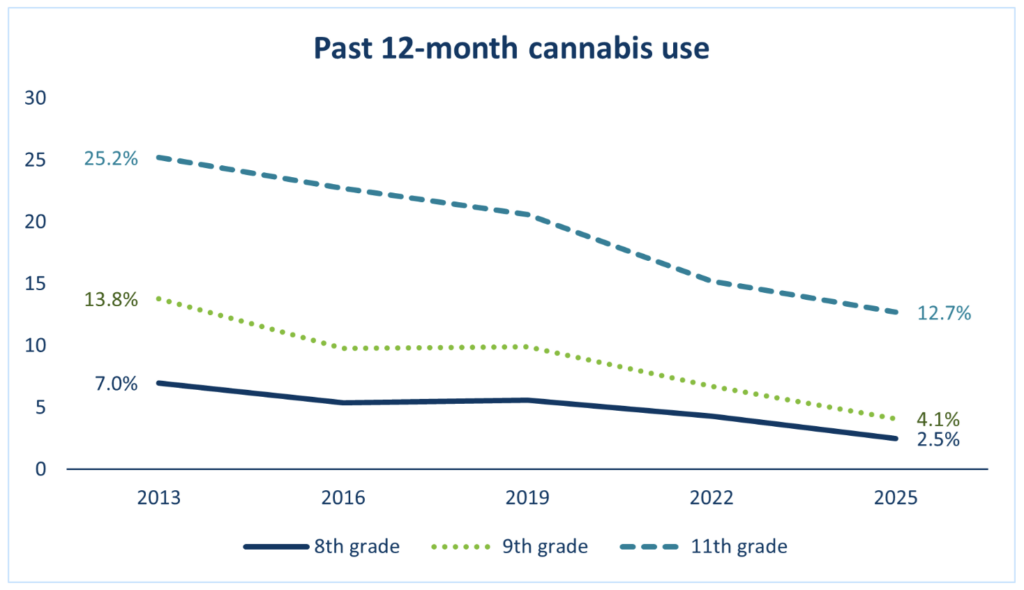
“There continues to be a steady decline in youth cannabis use since 2013, with 96% of students reporting not having used cannabis in the last month,” the state Department of Health said in a press release on Monday about the latest results of the Minnesota Student Survey, which is conducted every three years among students in grades 5, 8, 9 and 11.
Gov. Tim Walz (D) signed a bill to legalize marijuana in Minnesota in 2023, making the latest iteration of the survey the first to come since the prohibition of cannabis for adults over the age of 21 was ended.
State officials said the new data “showed healthier trends related to student use and perceptions of harms” about cannabis in recent years.
There has been a 57.7 percent statewide drop in self-reported past-year cannabis use from 2013 to 2025 among 8th, 9th and 11th graders combined. There has also been a decline over time in past-month use.
“Overall, self-reported cannabis use by students in Minnesota has continued to decrease each year since 2013,” a fact sheet on the results says.
More students also now view using marijuana once or twice a week as moderately to greatly harmful, “reversing the trend seen from 2013 to 2022,” the Department of Health said.
Interestingly, respondents in the survey greatly overestimated how many of their fellow students use marijuana.
“In 2025, 8th, 9th, and 11th grade students reported thinking that over half of their peers (54%) use cannabis, but 92% of students reported never using cannabis,” the fact sheet says.
Even though the survey shows overall that underage use of marijuana is declining in the legalization era, there was one concerning result that stood out in the data, state officials said.
“Despite positive trends, the student survey—indicates that some of our children are encountering cannabis at young ages,” Brooke Cunningham, Minnesota’s commissioner of health, said. “We need talk to our children about cannabis before they encounter it because we know the potential harms that early use can bring to their developing brains, mental health and futures.”
The Minnesota survey showing that legalization hasn’t led to a spike in teen marijuana use is largely consistent with the results of prior studies in other states and at the national level.
It also reinforces reform advocates’ position that creating a regulatory framework for cannabis where licensed retailers must check IDs and implement other security mechanisms to prevent unlawful diversion is a far more effective policy than prohibition, with illicit suppliers whose products may be untested and where age-gating isn’t a strictly enforced regulation.
To that point, a recent federally funded study out of Canada found that that youth marijuana use rates declined after the country legalized cannabis.
German officials similarly released a separate report on their country’s experience with legalizing marijuana nationwide that showed that fears from opponents about youth use, traffic safety and more have so far proved largely unfounded.
Last year, U.S. federal health data also indicated that while past-year marijuana use overall has climbed in recent years, the rise has been “driven by increases…among adults 26 years or older.” As for younger Americans, rates of both past-year use and cannabis use disorder, by contrast, “remained stable among adolescents and young adults between 2021 and 2024.”
Across the U.S., research suggests that marijuana use by young people has generally fallen in states that legalize the drug for adults.
A report from the advocacy group Marijuana Policy Project (MPP), for example, found that youth marijuana use declined in 19 out of 21 states that legalized adult-use marijuana—with teen cannabis consumption down an average of 35 percent in the earliest states to legalize.
Another survey from the U.S. Centers for Disease Control and Prevention (CDC) also showed a decline in the proportion of high-school students reporting past-month marijuana use over the past decade, as dozens of states moved to legalize cannabis.
Another U.S. study reported a “significant decrease” in youth marijuana use from 2011 to 2021—a period in which more than a dozen states legalized marijuana for adults—detailing lower rates of both lifetime and past-month use by high-school students nationwide.
Another federal report concluded that cannabis consumption among minors—defined as people 12 to 20 years of age—fell slightly between 2022 and 2023.
Separately, a research letter published by the Journal of the American Medical Association (JAMA) in 2024 said there’s no evidence that states’ adoption of laws to legalize and regulate marijuana for adults have led to an increase in youth use of cannabis.
Another JAMA-published study similarly found that neither legalization nor the opening of retail stores led to increases in youth cannabis use.
In 2023, meanwhile, a U.S. health official said that teen marijuana use has not increased “even as state legalization has proliferated across the country.”
Marijuana Moment is made possible with support from readers. If you rely on our cannabis advocacy journalism to stay informed, please consider a monthly Patreon pledge.
