
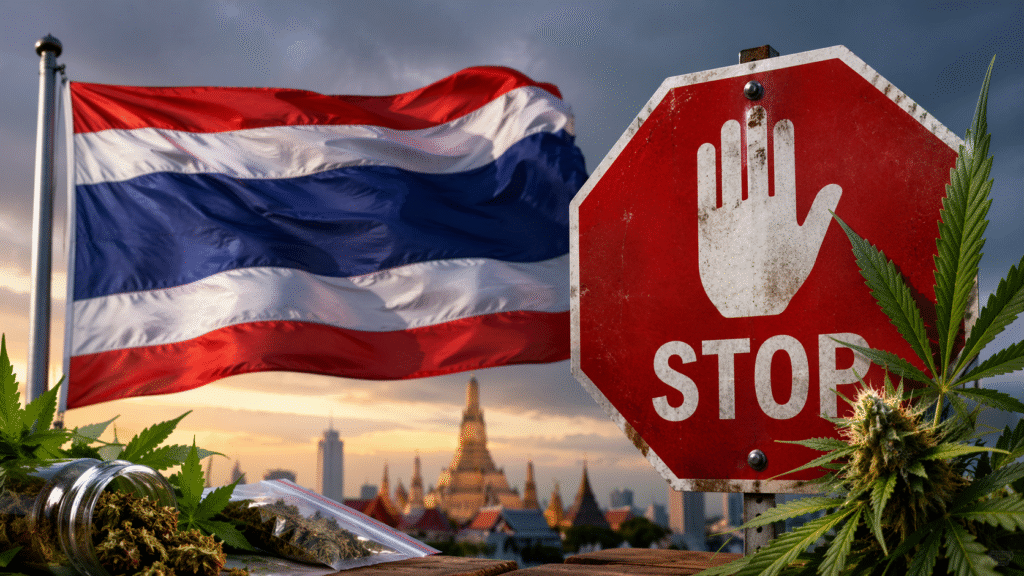

The ending feels almost tragic, especially for a story that, when it came to adult-use cannabis, once seemed destined to succeed.
In 2022, Thailand made history by becoming the first country in Southeast Asia to decriminalize adult-use cannabis, removing flower from the narcotics list and expanding a liberalization process that had begun in 2018 with the legalization of medical cannabis. The move sparked a frenzy both at home and abroad. Dispensaries on every corner of Bangkok, eye-popping sales figures, international cannabis tourism, and every imaginable form cannabis on the menu. But now, four years later, the Thai government is closing that door.
Authorities confirmed this week that Thailand will move toward an exclusively medical model, effectively eliminating legal adult-use cannabis and forcing thousands of businesses to either adapt or disappear.
What happened, Thailand? You used to be cool…
Under new rules announced by the Ministry of Public Health, traditional dispensaries as we know them today will cease to exist. Some will call it a “policy shift,” others a “ban,” but what’s happening in Thailand reflects a much more complex reality: an ideological reversal driven by a market liberalization that outpaced the state’s ability to regulate it.
Let’s rewind for a second. When cannabis was decriminalized in 2022, the government removed flower from the narcotics list, opening the door to tens of thousands of cannabis retailers. Before long, people were buying pre-rolls in front of historic landmarks, filming themselves smoking on rooftops, and choosing from extravagant strain menus with hundreds of options.
The problem was that the Thai government never built a robust regulatory framework at the same pace. In other words, the opening came before the rules. And then the market did what markets tend to do when demand, opportunity, and regulatory gray areas collide: it exploded.
In just a few years, Thailand went from having an emerging medical cannabis industry to becoming one of the world’s most visible cannabis markets. According to official figures, by the end of 2025, Thailand had registered 18,433 dispensaries. The figure proved unsustainable for a government that still had not clearly defined how it wanted to structure the sector. And naturally, criticism began to grow.
Conservative groups denounced what they called “excessive commercialization.” Some officials warned of uncontrolled cannabis tourism. Opposition figures promised to dismantle the gray market. Slowly but surely, the experiment became more politically costly than profitable.
The crackdown did not return all at once, of course… it came in layers. First came restrictions, then prescription requirements for access, then far stricter license renewals, and finally, the forced conversion to a medical-only model.
The impact is already visible: of the 8,636 licenses affected by the latest regulatory crackdown, only 1,339 were renewed. That means 7,297 businesses shut down. Thousands of operators were pushed out before the new system even fully took effect. As Thai activist Chokwan Kitty Chopaka put it, “the cannabis industry has become hostage to politics.”
From dispensary to clinic: the new medical model Thailand wants to enforce
Businesses that wish to continue operating will no longer be permitted to function as simple retail dispensaries. To maintain their licenses, they must convert into state-approved medical establishments, such as:
- Specialized clinics
- Pharmacies
- Traditional Thai medicine centers
- Other authorized healthcare institutions
They must also employlicensed healthcare professionals and sell cannabis strictly within a medical or therapeutic framework, generally tied to a prescription or professional recommendation.
In other words, cannabis will not disappear from Thai storefronts, but it will no longer be sold as a general consumer product.
The measure will not take effect immediately. The government acknowledges that businesses will need time to adapt and has therefore granted a three-year transition period. Still, the political message is clear: Thailand no longer wants cannabis sold as a mainstream retail good. It wants cannabis confined to a clinical framework.
Public Health Minister Pattana Phromphat said the government will continue supporting the industry, but under “stricter controls covering cultivation, extraction, and use.”
At the same time, authorities will roll out new enforcement tools, including national maps of licensed establishments, visible storefront stickers displaying active license status and expiration dates, and expanded inspection powers for additional state agencies.
According to Phongsathorn Phokphoemdee, director of Thailand’s Department of Traditional and Alternative Medicine, regulatory authority will now be shared among public health agencies, administrative bodies, and law enforcement.
Thailand isn’t letting go of cannabis, it’s medicalizing it
There is a fundamental difference between banning an industry and transforming it. Thailand has chosen the latter. While the adult-use market is being dismantled, the government is not exiting the cannabis business.
Thai authorities still view cannabis as a strategic economic opportunity, particularly in areas such as medical extraction, pharmaceutical formulations, cosmetics, industrial processing, and high-value exports. “If growers, extractors, and processors meet quality standards, the ministry will support domestic use first, and any surplus may eventually be exported,” Pattana said.
The Thai state’s vision appears to have shifted from one centered on access to one centered on industry. Fewer boutique dispensaries, more laboratories. More medical operators, more healthcare infrastructure, more industrial traceability.
Still, uncertainty and fear remain. While the government insists it does not seek to eliminate the industry but merely redirect it, some officials suggest the crackdown could go even further. Health Minister Somsak Thepsuthin has gone so far as to state that “cannabis will be classified as a narcotic in the future.”
If that happens, it would mark an even more dramatic shift than the current medicalization of the market and leave the door open to partial—or total—recriminalization down the road.
From cannabis paradise to global regulatory warning
For a time, Thailand once stood as living proof that cannabis could break through even in traditionally conservative regions. Today, its experience is becoming a different kind of example. Not necessarily about the limits of legalization, but about the risks of opening a market without first building the institutional architecture required to sustain it.
What happened in Thailand does not mean legal cannabis itself failed. Rather, it shows what happens when structural reform moves faster than the state apparatus tasked with managing it. In that sense, Thailand’s story may become a cautionary tale for other countries still debating their own regulatory path.
Opening a market is relatively easy. Governing it afterward is the hard part.
Cover photo created with AI.