Republican lawmakers have filed amendments to sweeping agriculture legislation that would push back the scheduled federal recriminalization of hemp THC products for another year and create a framework for continued legal sales, with new restrictions and clarifications.
Hemp derivatives with less than 0.3 percent delta-9 THC on a drug-weight basis were federally legalized under the 2018 Farm Bill that President Donald Trump signed during his first term in office. But late last year, Trump signed new legislation containing provisions that will redefine hemp to make it so only products with 0.4 milligrams of total THC per container will remain legal after November 12.
Now, House Oversight and Government Reform Committee Chairman James Comer (R-KY) is proposing to delay the ban until November 2027.
A separate proposal from Rep. Andy Barr (R-KY), according to the sponsor’s summary, “amends the definition of ‘Hemp’ to preserve the lawful hemp market while creating a regulatory framework that protects children, bans synthetics, and ensures that any products on the market place are of American origin.”
The Barr amendment was withdrawn on Wednesday after being submitted, however, for reasons that are unknown, and it’s unclear if the congressman intends to file a revised version at some point.
Submitted amendments to the Farm Bill, formally known as the Farm, Food, and National Security Act of 2026, or H.R. 7567, are expected to be considered next week by the Rules Committee. That panel will decide whether the proposals can receive votes on the House floor.
Rep. Jim Baird (R-IN) had filed a hemp ban delay amendment before the House Agriculture Committee when it took up the Farm Bill last month, but that panel’s chairman determined that the proposal was not germane to the legislation.
The Farm Bill as approved by the prior committee does contain some provisions aimed at aiding the hemp industry and farmers who grow cannabis for industrial purposes such as fiber and grain. For example, the legislation would amend existing statute related to the development of industrial hemp production regulatory plans by states and tribes—including surrounding polices for testing, sampling, background checks and record-keeping.
Here’s a summary of the hemp language in the 2026 Farm Bill from House Agriculture Committee staff:
“Sec. 10005. Hemp production.
Section 10006 amends subtitle G of the Agricultural Marketing Act of 1946.
Subsection (a) amends section 297B to require State and Tribal plans to include a procedure under which a hemp producer shall be required to designate the type of production of the hemp producer; allow State and Tribal plans to include a procedure for the use of visual inspections, performance-based sampling methodologies, certified seed, or a similar procedure when developing sampling plans for industrial hemp; allow State and Tribal plans to include a procedure for eliminating the 10-year period of ineligibility following the date of conviction for producers of industrial hemp with a felony related to a controlled substance; require documentation during inspections that demonstrates a clear intent to produce industrial hemp for producers under a State or Tribal plan that includes procedures for reducing or eliminating sampling or testing requirements for industrial hemp; allow testing if a producer of industrial hemp fails to provide required documentation; require the State or Tribe to report a producer of industrial to the Attorney General and applicable law enforcement officers if that producer violated the State or Tribal plan by producing a crop that is inconsistent with the designation of industrial hemp; and ban any person who knowingly produced a crop that is inconsistent with the designation of industrial hemp from obtaining a hemp license for 5 years.
Subsection (b) amends section 297C to require a Department of Agriculture plan to include a procedure under which a hemp producer shall be required to designate the type of production of the hemp producer; allow a Department of Agriculture plan to include a procedure for the use of visual inspections, performance-based sampling methodologies, certified seed, or a similar procedure when developing sampling plans for industrial hemp; allow a Department of Agriculture plan to include a procedure for eliminating the 10-year period of ineligibility following the date of conviction for producers of industrial hemp with a felony related to a controlled substance; require documentation during inspections that demonstrates a clear intent to produce industrial hemp for producers under a Department of Agriculture plan that includes procedures for reducing or eliminating sampling or testing requirements for industrial hemp; allow testing if a producer of industrial hemp fails to provide required documentation; and requires the Secretary to collect information related to the designation of the type of production of hemp producers and the laboratory certificate of analysis for hemp disposed of.
Subsection (c) amends section 297D to require the Secretary of Agriculture to establish a process by which the Department of Agriculture can issue certificates of accreditation to laboratories for the purposes of testing hemp.”
A committee report says the bill “recognizes the continued Congressional support for the industrial hemp industry, and maintains the bifurcation of industrial hemp from hemp-derived cannabinoid final form products that was put into statute through the Agriculture, Rural Development, Food and Drug Administration, and Related Agencies Appropriations Act, 2026.”
“It is the intention of the Committee that the Department work with States and Tribes to implement language included in this bill in such a way that allows States to best support those producers of industrial hemp products while maintaining State authority in making regulatory decisions that best reflect the needs of their constituents. Additionally, the Committee believes that the Department should prioritize their work in coordinating with the DEA to reduce the bottlenecks that occur due to a lack of appropriately accredited labs, as this issue has been an ongoing challenge for the producers of hemp that could impact the sector moving forward if not addressed.
The statutory framework for hemp laid out in this bill recognizes multiple primary agricultural outputs of the hemp plant, including fiber and grain, each of which involves the on-farm separation of the primary product from the cannabinoid- containing floral material of the plant. Terpenes follow this same production model. Terpenes are non-intoxicating aromatic compounds that originate in the flowering tops of the plant and are separated from cannabinoid-containing vegetative material during primary agricultural processing, in the same manner as grain is separated through threshing and fiber is separated through cutting and retting. Therefore, the Committee recognizes the production of the whole plant, or any lawful part thereof, for the extraction, production, or manufacture of any non-cannabinoid essential oil, aromatic compound, terpene, or other non-cannabinoid volatile organic compound derived from such plant as the production of industrial hemp, such that any cannabinoid components of such plant satisfactorily meet all other components of the definition of “hemp” as defined by Pub. L. 119-37.”
Comer and Kentucky Agriculture Commissioner Jonathan Shell sent a letter to Sen. Mitch McConnell (R-KY) in February imploring him to use his influence to avert the recriminalization, at least on a temporary basis, by supporting the proposed implementation delay.
While McConnell championed hemp legalization under the 2018 Farm Bill, however, the former Senate majority leader has supported unraveling the hemp THC market that he’s described as an unintended consequences of the broader agriculture legislation.
Meanwhile, a number of other bipartisan hemp reform bills are pending in Congress.
Last week, for example, Sens. Rand Paul (R-KY), Amy Klobuchar (D-MN) and Joni Ernst (R-IA) filed the Hemp Safety Enforcement Act, which would effectively let states opt out of the federal recriminalization of hemp THC products that is set to be enacted later this year.
Ernst on Wednesday, however, withdrew her name as a cosponsor of the legislation.
—
Marijuana Moment is tracking hundreds of cannabis, psychedelics and drug policy bills in state legislatures and Congress this year. Patreon supporters pledging at least $25/month get access to our interactive maps, charts and hearing calendar so they don’t miss any developments.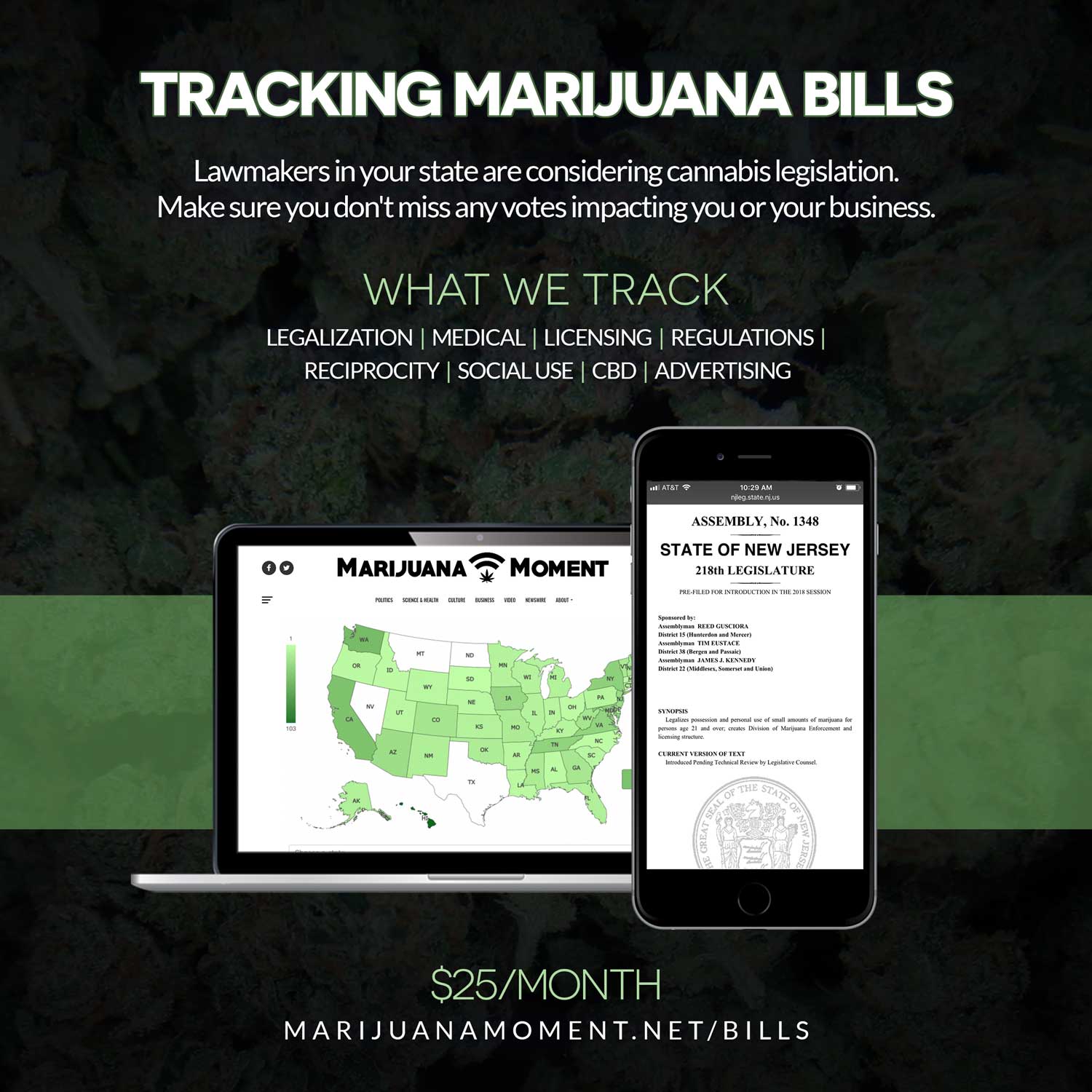
Learn more about our marijuana bill tracker and become a supporter on Patreon to get access.
—
Since 2018, cannabis products have been considered legal hemp if they contain less than 0.3 percent delta-9 THC on a dry weight basis.
The provisions set to take effect later this year specify that the weight will apply to total THC—including delta-8 and other isomers. It will also include “any other cannabinoids that have similar effects (or are marketed to have similar effects) on humans or animals as a tetrahydrocannabinol (as determined by the Secretary of Health and Human Services).”
The new definition of legal hemp will additionally ban “any intermediate hemp-derived cannabinoid products which are marketed or sold as a final product or directly to an end consumer for personal or household use” as well as products containing cannabinoids that are synthesized or manufactured outside of the cannabis plant or not capable of being naturally produced by it.
Legal hemp products will be limited to a total of 0.4 milligrams per container of total THC or any other cannabinoids with similar effects.
Within 90 days of the bill’s enactment, the Food and Drug Administration (FDA) and other agencies were supposed to publish list of “all cannabinoids known to FDA to be capable of being naturally produced by a Cannabis sativa L. plant, as reflected in peer reviewed literature,” “all tetrahydrocannabinol class cannabinoids known to the agency to be naturally occurring in the plant” and “all other known cannabinoids with similar effects to, or marketed to have similar effects to, tetrahyrocannabinol class cannabinoids.”
However, FDA appears to have missed that deadline. A spokesperson told Marijuana Moment in February that the lists would be posted in the Federal Register when they’re available, but that hasn’t yet happened.
A U.S. Department of Agriculture report published this month shows that farmers in the U.S. grew three-quarters of a billion dollars worth of hemp crops in 2025—a 64 percent increase from the prior year.
Meanwhile, the Trump administration this month launched a new initiative to cover up to $500 worth of hemp-derived products each year for eligible Medicare patients. The program being implemented by the Centers for Medicare & Medicaid Services (CMS) focuses largely on CBD but also allows a certain amount of THC in products.
Anti-marijuana organizations filed a lawsuit suit against the Medicare hemp coverage policy, and lawyers for Health and Human Services Sec. Robert F. Kennedy Jr. and CMS Director Mehmet Oz recently filed a brief asking that the case be dismissed.
Meanwhile, the White House Office of Management and Budget has been holding a series of meetings about a Food and Drug Administration (FDA) CBD products enforcement policy.
FDA also issued guidance making clear that it does not intend to interfere with implementation of the Medicare hemp-derived products coverage plan.
CMS separately finalized a rule that will allow coverage of some hemp products as specialized, non-primarily health-related benefits through Medicare Advantage plans.
As hemp products have become more popular with consumers, some large brands are attempting to get in on action.
Major retailer Target, for example, is expanding its participation in the hemp-derived THC beverage market. Last year, the company began a pilot program involving sales of cannabis drinks at 10 select stores in Minnesota. That apparently went well, and now the company has obtained licenses from Minnesota regulators to sell lower-potency hemp edible products—including THC drinks—at all 72 of its stores in the state.
Photo courtesy of Brendan Cleak.
Marijuana Moment is made possible with support from readers. If you rely on our cannabis advocacy journalism to stay informed, please consider a monthly Patreon pledge.
